

What Is Mutual Fund?
A mutual fund collects money from many investors and invests it according to a defined objective. The money may go into shares, bonds, government securities, money market instruments, or a mix of these assets.
For a simple example, suppose 10,000 people invest small amounts into one fund. The fund manager invests the combined pool based on the scheme mandate. Each investor receives units. The value of those units changes with the value of the underlying investments.
That is the basic answer to what is mutual fund.
- What Is Mutual Fund?
- How Mutual Funds Work With Your Money
- The Three Main Types of Mutual Funds
- SIP, Lump Sum and the Reality of Timing
- What Is XIRR in Mutual Fund and Why Investors Should Understand It
- Mutual Fund Nifty 50 and the Role of Index Funds
- Frequently Asked Questions – What is Mutual Fund
- What should I gain to invest in an SBI mutual fund?
- Can we buy an SBI mutual fund using the SBI YONO app?
- Is it currently safe to invest in SIPs through SBI Mutual Fund?
- How To Invest In SBI Mutual Fund?
- What are some good SBI mutual funds for small investors?
- What are three types of mutual funds?
- Which is better, FD or MF?
However, the real learning starts after this definition. A mutual fund is not one single investment. Every scheme has its own portfolio, risk level, cost structure, investment style, and holding pattern. Therefore, choosing a fund only because it gave high returns in the past can lead to poor decisions.
We have seen investors enter a fund after a strong one-year return and then worry when the next year looks weak. This happens because the investor often understands the return number before understanding the investment behind it.
A good investment decision starts with the purpose of the money. Then comes the time available, risk capacity, liquidity need, and the actual scheme.
How Mutual Funds Work With Your Money
When you invest, you buy units at the applicable Net Asset Value, known as NAV. The fund then holds investments based on its stated objective.
For example, an equity mutual fund mainly invests in shares. A debt fund invests in fixed-income securities. A hybrid fund combines equity and debt in different proportions.
The NAV rises or falls as the value of the fund’s holdings changes.
However, NAV alone does not tell you whether a fund is cheap or expensive. A ₹20 NAV and a ₹200 NAV cannot be compared in that way. What matters is the portfolio value per unit and how the fund performs against its objective and benchmark over time.
You should also check the expense ratio. This is the annual cost charged for managing and operating the scheme. A small difference can affect long-term returns when money stays invested for many years.
Therefore, learning how to invest in mutual funds should include scheme documents, portfolio holdings, risk level, expense ratio, exit load, benchmark, and investment horizon.
The Three Main Types of Mutual Funds
Equity Mutual Funds
These funds invest mainly in shares. They can offer strong long-term growth potential. At the same time, their value can fall sharply during market corrections.
Large-cap, mid-cap, small-cap, flexi-cap, sectoral, thematic, ELSS, and index funds fall within the broader equity space.
Small-cap funds, for instance, can show high returns during strong market phases. However, concentration risk and liquidity risk can become important during difficult periods. A sector fund also carries concentration risk because its portfolio depends heavily on one part of the economy.
Debt Mutual Funds
Debt funds invest in instruments such as government securities and corporate bonds. Their risks are different from equity market risk.
Interest rate risk can affect bond prices. Credit quality also matters. A change in interest rates or concern about an issuer’s ability to repay can affect the fund’s value.
Therefore, debt funds should not be treated as fixed deposits simply because both deal with relatively stable forms of investing.
Hybrid Mutual Funds
Hybrid funds combine more than one asset class. The equity and debt allocation depends on the scheme.
These funds can suit investors who want one portfolio with a defined asset mix. However, the actual risk depends on the scheme’s allocation rules. Always read how much equity exposure the fund can take.
SIP, Lump Sum and the Reality of Timing
A Systematic Investment Plan, or SIP, allows you to invest a fixed amount at regular intervals. It can help create discipline and spread purchases across different market levels.
However, an SIP does not guarantee profits or remove market risk.
Suppose an investor starts a monthly SIP when markets are high. The market then falls for several months. The account value may show a loss. This can feel uncomfortable. Yet the SIP continues to buy units at lower prices during the decline.
The result depends on the fund, the market cycle, the investment period, and whether the investor continues with a plan that matches the original goal.
Lump-sum investing requires another level of thought. The source of money, market exposure already held, and time horizon all matter.
For long-term equity goals, trying to predict the perfect entry date can delay action. At the same time, investing a large amount without checking risk capacity can create pressure during a market fall.
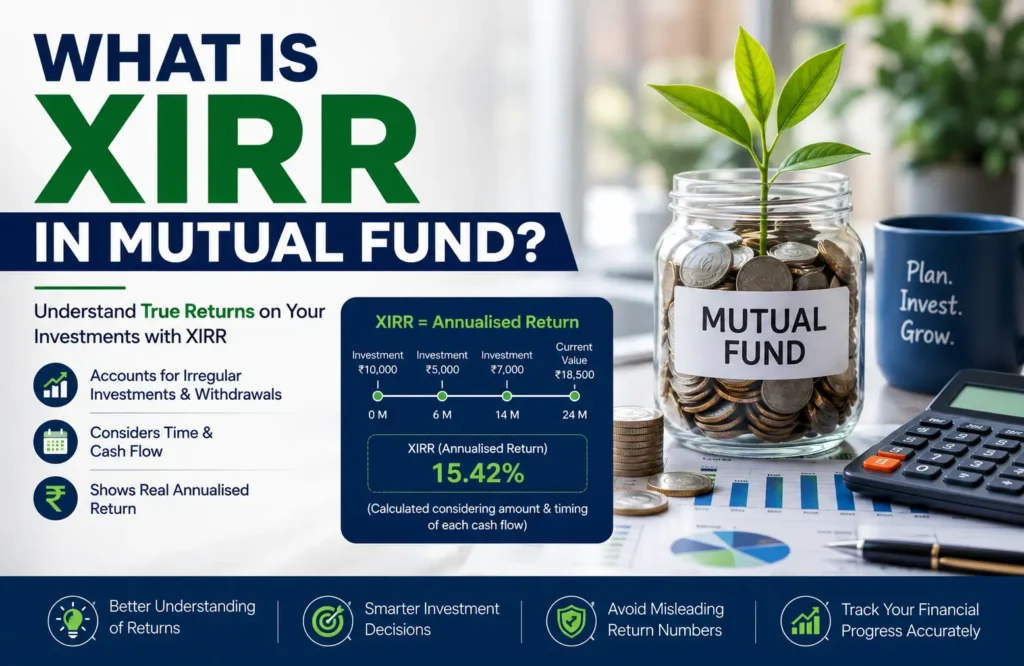
What Is XIRR in Mutual Fund and Why Investors Should Understand It
Many investors make several investments and withdrawals over time. In such cases, a simple return calculation may not show the full picture.
This is where what is XIRR in mutual fund becomes important.
XIRR measures the annualised return by considering the date and amount of each cash flow. It is useful for SIPs and irregular investments because every payment may stay invested for a different period.
For example, ₹5,000 invested three years ago and ₹5,000 invested last month should not be treated as if both amounts were invested for the same duration.
XIRR gives a more realistic view of your investment return.
Still, do not judge a fund through XIRR alone. Compare the return with the fund’s benchmark, category, risk taken, and the period measured.
Mutual Fund Nifty 50 and the Role of Index Funds
A mutual fund Nifty 50 generally refers to an index fund or exchange-traded product designed to track the Nifty 50 index.
The objective is to follow the index as closely as possible. This brings two important factors into focus: expense ratio and tracking error.
Tracking error shows how closely a fund follows its benchmark. Some difference will occur because of expenses, cash holdings, trading costs, and portfolio management factors. A wider tracking gap over time deserves attention.
Index investing can be easy to understand. However, investors should still know what the index contains and how much of their portfolio depends on large-cap Indian companies.
Risks That Deserve More Attention
A mutual fund investment can face market risk, concentration risk, liquidity risk, interest rate risk, and fund-specific risks.
Style drift is another issue worth watching. It occurs when a fund gradually moves away from the investment style investors expected. A fund manager change can also affect how a portfolio is managed.
Fund manager risk becomes more relevant in actively managed schemes. Therefore, review whether the fund’s process is strong enough to survive changes in personnel.
Investors should also remain alert to front-running and scams. Never transfer money to an unknown person who promises fixed returns through a mutual fund. Use recognised investment platforms and verify the scheme before acting.
A mutual fund is a regulated investment product. Yet regulation does not remove market risk.
How to Make a Practical Investment Decision
Start with the goal. A child’s education plan, retirement corpus, home purchase, and emergency reserve have different timelines.
Next, decide how much market movement you can handle without making a rushed exit.
Then review the scheme. Check its investment objective, portfolio, expense ratio, exit load, riskometer, benchmark, tracking error where relevant, and past consistency.
For an investor ready to act, the next step is simple: choose the right investment route, complete the required KYC process, select a suitable scheme, and invest according to a written plan.
Mutual fund investing works best when the decision is clear before the money goes in. Returns matter. Risk matters too. Costs matter. Time matters most when the goal needs years to grow.
Frequently Asked Questions – What is Mutual Fund
What should I gain to invest in an SBI mutual fund?
You need a clear investment goal, basic risk understanding, completed KYC, and money that matches your investment horizon. Review the specific scheme before investing. The fund house name alone should not decide the investment.
Can we buy an SBI mutual fund using the SBI YONO app?
Investment availability can depend on the current features and linked services available in the app. Check the latest investment section and scheme access before placing an order. Also verify the exact scheme, plan, and option selected.
Is it currently safe to invest in SIPs through SBI Mutual Fund?
An SIP through any mutual fund carries market risk based on the chosen scheme. Safety depends on the underlying fund, asset class, time horizon, and your ability to stay invested during market falls. A SIP is an investment method, not a return guarantee.
How To Invest In SBI Mutual Fund?
Complete KYC first. Then choose a suitable investment route, review the scheme details, select the investment amount and frequency, and confirm the transaction. Before investing, check the fund objective, risk level, expense ratio, portfolio, and exit load.
What are some good SBI mutual funds for small investors?
A suitable fund depends on the investor’s goal and risk capacity. Small investment amounts can still be invested through SIPs. Broad-market index funds, diversified equity funds, hybrid funds, or debt-oriented options may fit different needs. Scheme selection should follow the goal.
What are three types of mutual funds?
The three broad types are equity mutual funds, debt mutual funds, and hybrid mutual funds. Each type carries different risks and invests in different asset classes.
Which is better, FD or MF?
An FD and a mutual fund serve different purposes. Fixed deposits provide defined terms and known interest conditions, while mutual fund returns depend on market and scheme performance. The right choice depends on your goal, time horizon, liquidity needs, tax position, and risk capacity.