
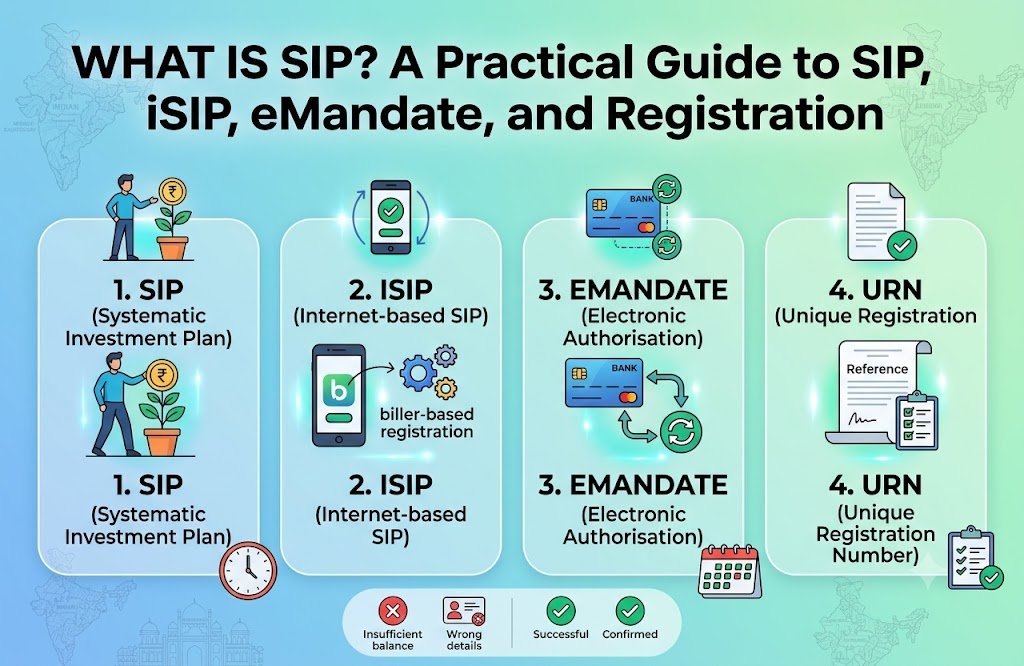
When people search what is SIP, they usually want a simple answer. SIP stands for Systematic Investment Plan. It allows an investor to put a chosen amount into a mutual fund at regular intervals. The real picture, however, starts after the SIP is registered. The money has to move from the bank account, the mandate has to work, and the instalment has to reach the mutual fund correctly.
For an investor in Chandigarh, Mohali, Delhi, Mumbai or any other Indian city, these small operational details matter. A SIP can be financially well planned and still fail because of an inactive mandate, insufficient balance, incorrect bank details or a missed registration step.
This guide explains the working side of SIPs, including iSIP, eMandate, URN, registration, failed instalments, cancellation and modification.
- SIP in Simple Terms
- Answer : What Is SIP?
- iSIP, SIP and eMandate Are Not the Same Thing
- iSIP vs SIP vs eMandate
- How to Register an iSIP
- What Is a URN in SIP?
- Why Does a SIP Payment Fail?
- What Happens After a Failed SIP?
- Can You Cancel or Modify a SIP?
- SIP Pause Is Different From SIP Cancellation
- What Happens to Existing Money When You Stop a SIP?
- A Practical Check Before Starting Any SIP
- FAQs About SIP, iSIP, URN and eMandate
- 1. What is SIP in a mutual fund?
- 2. What is iSIP in mutual funds?
- 3. Is iSIP the same as SIP?
- 4. What is an eMandate for SIP?
- 5. What is URN in iSIP?
- 6. What happens if my SIP fails once?
- 7. Can repeated SIP failures cancel my SIP?
- 8. Can I cancel my SIP anytime?
- 9. Does cancelling a SIP withdraw my mutual fund investment?
- 10. Can I increase my SIP amount?
- 11. Can I change my bank account for an existing SIP?
- 12. Is SIP guaranteed to make money?
- 13. Is eMandate better than iSIP?
- 14. Should I stop my SIP when the market falls?
- 15. What should I check after registering a SIP?
- The Part of SIP That Investors Usually Learn Later
SIP in Simple Terms
A SIP is a method of investing a fixed amount into a mutual fund scheme at a chosen frequency.
For example, an investor may decide to invest ₹5,000 every month in an equity mutual fund. The amount is debited according to the registered payment instruction, and units are allotted based on the applicable NAV.
The important point is simple: SIP is an investment method, not a separate mutual fund product.
The risk still comes from the mutual fund scheme selected. An equity SIP remains exposed to equity-market movements. A debt-fund SIP has its own interest-rate, credit and liquidity risks.
Answer : What Is SIP?
SIP, or Systematic Investment Plan, is a method of investing a fixed or chosen amount into a mutual fund at regular intervals such as monthly or quarterly. The SIP creates a structured investment habit, while the actual risk and return depend on the mutual fund scheme selected.
A SIP does not promise a fixed return. It also does not prevent temporary losses.
What it does is create a regular investment process. Each instalment buys units at the applicable NAV on that investment date.
iSIP, SIP and eMandate Are Not the Same Thing
This is where many investors get confused.
SIP describes the investment method.
iSIP generally refers to an online or Internet-based way of registering a SIP. Depending on the AMC or platform, the investor may complete the registration through Internet banking and, in biller-based systems, receive a URN for bank-side registration.
eMandate is the electronic authorisation that permits recurring debits from the investor’s bank account. Modern eNACH/eMandate systems can allow multiple SIPs to operate through a registered mandate, depending on the platform and AMC.
The distinction becomes important when an investor wants to understand why a SIP is active but a payment mandate is pending, or why changing the bank account may require a new mandate.
iSIP vs SIP vs eMandate
| Feature | SIP | iSIP | eMandate |
| What it means | Regular mutual fund investment method | Online method for registering a SIP | Electronic authorisation for recurring bank debits |
| Main purpose | Invest periodically | Start/register SIP digitally | Authorise automatic payments |
| Investment method | Monthly, quarterly or other permitted frequency | Usually used to establish an online SIP | Used to automate SIP instalment debits |
| Paperwork | Depends on registration route | Generally paperless | Generally paperless |
| URN | Not necessarily required | May be generated in biller-based registration | Usually uses mandate identification rather than iSIP URN |
| Bank involvement | Required for payment | Internet banking may be required | Bank/NPCI authorisation is involved |
| Multiple SIPs | Depends on mandate arrangement | Often linked to individual registration | A single mandate may support multiple SIPs where the platform permits |
| What the investor should remember | It is the investment plan | It is a registration route | It is the payment authorisation |
The practical difference is worth remembering: SIP tells you what you are investing regularly; iSIP can describe how the SIP is registered online; eMandate authorises the recurring debit.
How to Register an iSIP
The exact screen names differ between AMCs and platforms. The broad process, however, usually follows a familiar sequence.
Step 1: Complete KYC and investor details
Your PAN, personal information, bank details and other required investor information must be correctly registered.
An incomplete or mismatched investor record can stop the registration before the SIP even begins.
Step 2: Select the mutual fund scheme
Choose the scheme, plan and option carefully.
This is where investment decisions matter. The payment method cannot correct a poor fund choice.
Step 3: Enter the SIP details
You normally select:
- SIP amount
- SIP date
- Frequency
- Duration or end date, where applicable
- Bank account
- Other required investor details
Check every number before submitting.
Step 4: Submit the online registration
After submission, the platform may generate a registration reference or URN where the particular iSIP process uses biller registration.
Step 5: Complete the bank-side authorisation
If the iSIP route requires biller registration, log in to your bank’s Internet banking facility and add the relevant mutual fund biller using the URN.
The exact validity period and process can differ between AMCs and banks, so the instruction displayed during registration should be followed.
Step 6: Check the registration status
Do not stop after receiving the registration number.
Check whether the SIP is actually shown as registered or active. A generated reference number does not by itself mean that every future debit has been successfully activated.
What Is a URN in SIP?
URN stands for Unique Registration Number.
In a biller-based iSIP process, the URN connects the online SIP registration with the bank-side biller setup. The investor may need to enter this number while registering the mutual fund as a biller through Internet banking.
Think of the URN as a registration reference.
It can also become useful when discussing an unsuccessful registration with the AMC or service provider because it helps identify the particular request.
However, URN is not the same as the SIP itself.
An investor can have a SIP request, a bank mandate and a URN as separate parts of the same payment setup.
The important step is to complete the bank-side registration within the validity period given by the AMC. Some AMC documentation, for example, specifies a limited period such as 10 days for URN registration. The period is not universal, so investors should follow the instruction attached to their particular registration.
Why Does a SIP Payment Fail?
A failed SIP instalment deserves attention. One failed debit does not automatically mean the investment plan has permanently disappeared, but repeated failures can lead to discontinuation under applicable AMC terms.
Common reasons include:
Insufficient Bank Balance
This is one of the most obvious causes.
If the SIP amount is ₹10,000 and the available balance is lower when the debit is attempted, the bank may reject the transaction.
Wrong or Inactive Bank Details
A closed account, incorrect account information or an account mismatch can interrupt the mandate.
Mandate Not Registered
An investor may complete the mutual-fund application but fail to finish the bank-side authorisation.
The SIP then exists on one side while the payment instruction is incomplete.
Mandate Expired
A mandate has its own validity conditions. Once it expires, future debits can stop until a valid mandate is registered.
Bank or Payment-System Issue
Technical problems at the bank, payment gateway or related payment infrastructure can also cause a failed transaction.
Date and Processing Issues
A SIP date falling on a non-business day or a payment instruction reaching the system late can affect processing. The exact treatment depends on the applicable process and fund documentation.
Repeated failed instalments matter because SEBI/AMFI material currently recognises three consecutive failures for daily, weekly, fortnightly and monthly intervals, while certain longer-frequency SIPs can be discontinued after two consecutive failures. Investors should still check the terms applicable to their AMC and SIP.
What Happens After a Failed SIP?
The first step is to identify the reason.
Check your bank statement and the SIP status shown by the AMC, RTA or investment platform.
Then verify:
- Bank balance
- Bank account status
- Mandate status
- SIP registration status
- Next debit date
- Any message received from the AMC or bank
Do not assume that simply adding money to the account will restart a SIP that has already been cancelled.
If repeated failures have caused the SIP to cease, a fresh SIP registration may be required.
Also remember that a failed SIP instalment does not redeem the units you already own. Your existing mutual fund investment remains invested unless you separately place a redemption request.
Can You Cancel or Modify a SIP?
Yes, but there is an important distinction between changing the SIP and cancelling the underlying bank mandate.
For a simple SIP change, the available options depend on the AMC or platform. You may be able to change the amount, date, frequency or duration through the online investor portal.
Some changes, especially a bank-account or mandate change, may require cancellation of the existing mandate followed by registration of a new one.
That is why investors should check the exact service request before cancelling anything.
To Cancel a SIP
A typical process is:
- Log in to the AMC, RTA or investment platform.
- Open the active SIP section.
- Select the SIP you want to stop.
- Choose the cancellation option.
- Confirm the request.
- Check the status after processing.
The cancellation of the SIP stops future scheduled investments. It does not automatically redeem the units already accumulated in the mutual fund.
The exact effective date depends on the AMC’s process and whether the next debit instruction has already been sent.
To Modify a SIP
If modification is available, review:
- Existing SIP amount
- New SIP amount
- SIP date
- Frequency
- End date
- Bank mandate
- Scheme details
If the platform does not allow the required modification, the usual route may involve cancelling the existing SIP and registering a fresh one.
Never cancel an active mandate first without checking whether another SIP is using it.
SIP Pause Is Different From SIP Cancellation
This distinction becomes useful when income temporarily falls.
Suppose a business owner in Ludhiana has a weak month, or a salaried investor has a large planned expense. The investor may want to stop the upcoming instalments temporarily.
Where the AMC provides a SIP Pause facility, the investor can pause eligible instalments for the permitted period.
Cancellation is permanent for that SIP instruction.
Pause is temporary.
The availability, duration and conditions are AMC-specific. SEBI documentation also recognises SIP Pause facilities, subject to the applicable scheme and AMC terms.
What Happens to Existing Money When You Stop a SIP?
This is one of the most misunderstood parts.
Stopping a SIP only stops future contributions.
Suppose you invested ₹2 lakh over several years and then cancel the SIP. The ₹2 lakh already invested remains in the mutual fund scheme.
Its value will continue to move with the NAV.
If you want to take that money out, you need to submit a separate redemption request.
This distinction is important during market corrections. An investor may stop future SIP instalments while still holding the existing portfolio.
A Practical Check Before Starting Any SIP
Before pressing the final registration button, look at the entire setup.
Ask yourself:
- Is the fund suitable for the goal?
- Can the monthly amount be maintained comfortably?
- Is the bank account active?
- Is there enough balance around the debit date?
- Has KYC been completed?
- Is the mandate registered?
- If using iSIP, has the URN been registered where required?
- Do you know how to cancel or modify the SIP later?
- Have you checked the scheme’s expense ratio, exit load and risk level?
This small check prevents many avoidable problems.
A SIP works smoothly when the investment decision and payment setup are both handled properly.
FAQs About SIP, iSIP, URN and eMandate
1. What is SIP in a mutual fund?
SIP stands for Systematic Investment Plan. It allows an investor to invest a chosen amount into a mutual fund at regular intervals. SIP is a method of investing, while the mutual fund scheme determines the investment risk.
2. What is iSIP in mutual funds?
iSIP generally refers to an Internet-based or online SIP registration facility. It allows investors to initiate SIP registration digitally, often through an AMC’s website and Internet banking. The exact process varies by AMC.
3. Is iSIP the same as SIP?
No. SIP is the regular investment method. iSIP generally refers to an online registration route used to set up that SIP.
4. What is an eMandate for SIP?
An eMandate is an electronic authorisation that permits recurring debits from a bank account for eligible investment transactions. Depending on the platform, one registered mandate may support multiple SIPs.
5. What is URN in iSIP?
URN means Unique Registration Number. In biller-based iSIP registration, it can be used to connect the SIP registration request with the bank-side biller registration.
6. What happens if my SIP fails once?
First check the reason for the failed debit. Common causes include insufficient balance, bank-account problems, mandate issues or technical failures. A single failure does not necessarily mean that the SIP has been permanently cancelled.
7. Can repeated SIP failures cancel my SIP?
Yes. Under the current general framework, repeated failed instalments can result in SIP discontinuation. SEBI/AMFI material specifies three consecutive failures for certain shorter frequencies and two for certain longer frequencies, subject to the applicable AMC terms.
8. Can I cancel my SIP anytime?
A SIP can generally be discontinued by submitting a valid cancellation request, subject to the AMC’s applicable process and cut-off requirements. If a debit instruction has already been sent, that instalment may still be processed.
9. Does cancelling a SIP withdraw my mutual fund investment?
No. Cancelling a SIP stops future instalments. The units already purchased remain in your mutual fund folio until you separately redeem them.
10. Can I increase my SIP amount?
Many AMCs and platforms provide SIP modification or top-up facilities. The exact option depends on the scheme, AMC and registration method.
11. Can I change my bank account for an existing SIP?
It may be possible, but the process depends on the mandate structure. In some eMandate systems, changing the bank can require cancellation of the existing mandate and registration of a new one.
12. Is SIP guaranteed to make money?
No. SIP does not guarantee returns. The result depends on the underlying mutual fund, market movement, investment period, costs and investor behaviour.
13. Is eMandate better than iSIP?
There is no universal answer. eMandate can simplify recurring debit authorisation and may allow multiple SIPs under one mandate on supported platforms. iSIP can be convenient when the AMC provides a biller-based online registration process. The better route depends on the AMC, bank and investor’s requirements.
14. Should I stop my SIP when the market falls?
A market fall alone does not provide enough information to decide whether a SIP should stop. The decision should be linked to the fund’s suitability, financial goal, risk capacity and overall portfolio. A falling NAV also means new SIP instalments purchase more units for the same amount.
15. What should I check after registering a SIP?
Check the SIP status, mandate status, bank account, first debit date and confirmation from the AMC or platform. This simple verification can catch a registration problem before the first instalment fails.
The Part of SIP That Investors Usually Learn Later
Starting a SIP takes minutes. Managing one properly requires more attention.
The fund selection matters. The investment horizon matters. Costs matter. So does the payment system sitting behind every instalment.
An investor who understands the difference between SIP, iSIP, eMandate and URN can identify a payment problem without confusing it with an investment problem.
That clarity becomes especially useful when an instalment fails, a bank account changes, a mandate expires or the investor decides to modify the monthly amount.
A SIP is simple at the surface. The details underneath deserve equal attention.